By Orch8 Engineering · Editorial policy
How to Test Automation Workflows Before Production
Test an automation against expected business outcomes, not only successful executions. Keep sanitized fixtures for normal, empty, malformed, duplicate, timeout, and rate-limited inputs; verify destination records; then run one canary after deployment. Separate test credentials from production writes.
What is the practical answer?
Test an automation against expected business outcomes, not only successful executions. Keep sanitized fixtures for normal, empty, malformed, duplicate, timeout, and rate-limited inputs; verify destination records; then run one canary after deployment. Separate test credentials from production writes.
Evidence: r/n8n: how to test automations before production · r/n8n: production workflow checklist · n8n: create separate development and production environments
Write the expected business result first
A manual run proves only the example you tried. An automation can finish green after processing zero records or writing the wrong destination object. Define the effect before selecting test data: for each eligible lead, create or update one CRM record and retain its source ID. The CRM record, source ID, and completion time are observable evidence; a green node is not.
A builder in the linked n8n discussion wanted regression scenarios after a lead-enrichment flow returned zero results in production. That is a useful question, not evidence that every zero-result run is a failure. A quiet period may legitimately contain no leads. Set the expectation from the source and schedule.
| Input | Expected outcome | Failure to catch |
|---|---|---|
| One valid lead | One CRM upsert with the mapped email | Duplicate contact |
| Unexpectedly empty source | Visible anomaly or reviewed no-op | Unexplained green run |
| Missing required email | Rejected record with reason | Empty contact |
| Same event delivered twice | One logical update | Two sales tasks |
| Timeout after a write | Reconcile by stable source ID | Blind second write |
| HTTP 429 | Delayed retry within a budget | Immediate retry loop |
Use fixed fixtures for decisions and sandboxes for contracts
Save sanitized payloads that exercise missing fields, duplicates, unexpected arrays, and old schema versions. Feed them through a development copy of the workflow and assert the normalized output. Replace external writes with stubs or test accounts. Replaying a prior execution against live credentials may repeat a real side effect.
Run a smaller integration suite against provider sandboxes where available. Check credentials, response shape, pagination, and actual provider error responses. A mock cannot reveal an expired token, while a live API cannot reliably manufacture every edge case. Keep both layers and know which question each answers.
Turn every incident into a regression fixture
Keep the smallest sanitized input that reproduces a failure. Remove secrets and customer information before storing it with the workflow. For lead enrichment, one fixture might return no enrichment data; another might omit the industry field. Assert the destination record or explicit rejection, not that a node merely executed.
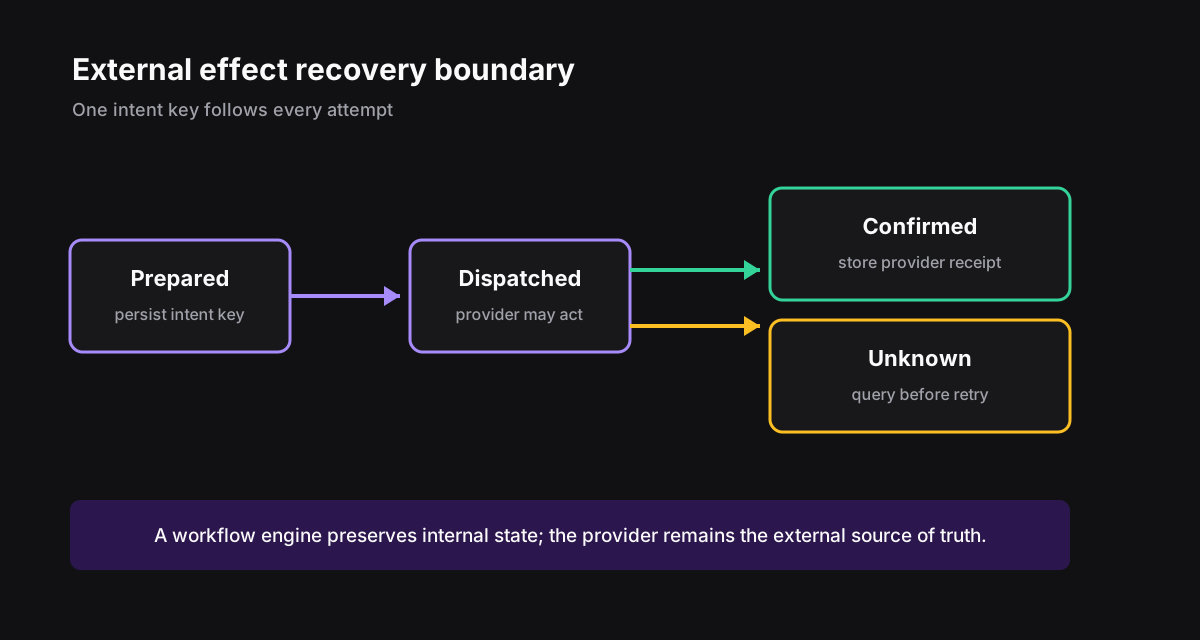
For a side-effecting step, deliver the same logical event twice, preferably concurrently, and inspect the destination. The expected result is one intended business effect. Reuse a provider idempotency key when supported; otherwise maintain a stable application-side operation ID and reconcile ambiguous responses.
Keep the release gate short enough to run every time
Fixtures reduce preventable releases; they do not replace monitoring. A provider can change after you deploy. Keep a contract probe for critical APIs and an external check that the automation still produces its intended result.
- Run normal, empty, malformed, duplicate, timeout, and 429 fixtures.
- Compare destination records with expected records, not execution status alone.
- Keep test and production credentials separate.
- Name the human who receives failed-run and missing-run alerts.
- Check that rollback will not repeat already accepted writes.
- Send one canary event after deployment and verify its downstream receipt.
Sources and further reading
Official references support technical claims; community discussions are used only as problem signals.