By Orch8 Engineering · Editorial policy
Build vs Buy a Workflow Orchestrator: A Practical Decision Model
Build when orchestration is a core differentiator, your required semantics are narrow, and a team can own persistence, leases, retries, migrations, observability, and on-call for years. Buy or adopt an engine when those are infrastructure concerns. Keep cron or a queue when the process does not need durable multi-step state.
What is the practical answer?
Build a workflow orchestrator only when orchestration semantics are a durable product differentiator and a team can own them for years. The system includes far more than a state machine: transactional transitions, task leases, timers, retries, concurrency, migrations, version compatibility, observability, control operations, authentication, tenant isolation, SDK contracts, security patches, and on-call recovery. Adopt an engine when those capabilities are infrastructure rather than the product. Keep cron when one scheduled task can restart safely, and use a queue when independent jobs need throughput or backpressure without durable multi-step state. Compare options with one difficult production process, then inject worker death, an ambiguous external response, and a breaking deployment while runs remain active. Measure the recovery steps and code your team must own, not only happy-path implementation time. Include a three-year operating estimate and an exit path through exportable state, standard protocols, or a bounded adapter before choosing.
Evidence: CNCF: Cloud Native Landscape · AWS Well-Architected: operational excellence · Reddit: warning about a custom orchestrator
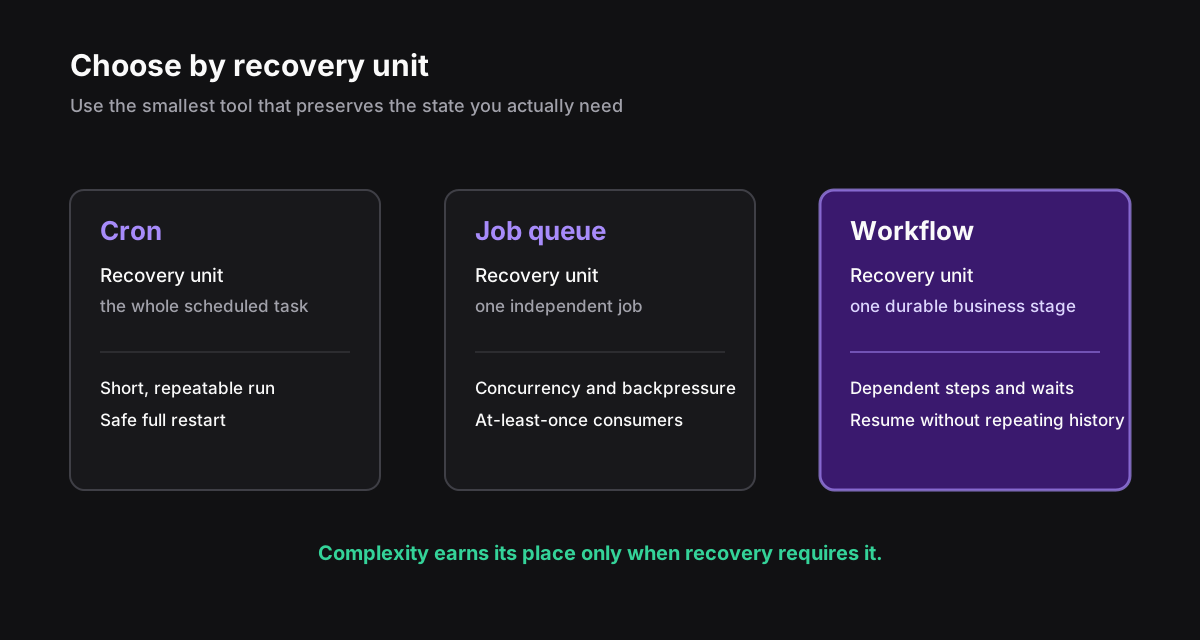
First decide whether you need an orchestrator#
A scheduled script and an independent job queue are cheaper mental models. Durable orchestration earns its cost when a business process crosses failures, deployments, long waits, approvals, or external side effects that cannot safely restart from the beginning.
Write the recovery unit for your hardest process. If the answer is the whole job, improve the job. If the answer is a named step with durable state, evaluate orchestration.
Price the invisible system#
| Capability | Build work | Long-term ownership |
|---|---|---|
| State transitions | Schema and transactions | Migration invariants |
| Leases and retries | Scheduler and timers | Clock and partition failures |
| Operations | UI, metrics, controls | On-call and support |
| Security | Auth, tenancy, secrets | Patching and audits |
| SDKs | Client and worker contracts | Compatibility across releases |
Use a reversible evaluation#
Orch8 is a self-hostable option for teams that prefer JSON definitions, persisted state, and HTTP or pull workers. Compare it with Temporal, queue-native tools, managed services, and doing less. The right answer depends on the recovery contract and the team that will operate it.
- Model one painful production process in two candidate approaches.
- Inject worker death and ambiguous external responses.
- Deploy a breaking workflow change with active runs.
- Measure operator steps, recovery time, and code your team owns.
- Estimate three-year operations and migration cost.
- Define an exit path: exportable state, standard protocols, or a bounded adapter.
What are you really committing to build?#
The visible state machine is a small part of an orchestrator. Production ownership includes transactional transitions, timers, leases, retries, backoff, concurrency, cancellation, version compatibility, state migrations, schema validation, worker protocols, access control, tenant isolation, audit records, metrics, search, operator controls, backups, restores, and upgrade rollback. Each feature interacts with failure timing.
Inventory capabilities as contracts and evidence, not nouns. For retries, specify which errors retry, how attempts persist, how jitter works, and how external effects remain safe. For leases, specify claim, heartbeat, expiry, stale completion, shutdown, and clock behavior. For versioning, specify what happens to a run started months before the current deploy.
Separate must-have semantics from convenience. If the only requirement is delayed independent jobs with retries, a maintained queue may cover it. If the product differentiates through portable execution or domain-specific scheduling, owning a narrow orchestrator may be rational—provided the team funds the operational surface.
| Area | Prototype work | Permanent ownership |
|---|---|---|
| Persistence | state tables | migrations, restore, corruption handling |
| Dispatch | poll endpoint | leases, fairness, partitions, shutdown |
| Recovery | retry loop | effect safety, backfills, controls |
| Visibility | status page | search, audit, retention, redaction |
| SDKs | one client | compatibility, releases, language support |
How do you compare three-year cost?#
Model people, infrastructure, incidents, compliance, and migration. People include feature development, maintenance, documentation, support, security response, and on-call. Infrastructure includes databases, backups, observability, test environments, and capacity headroom. Incidents include recovery time and customer impact, not only cloud charges.
For a vendor or adopted engine, include subscription, usage, required databases, self-hosting labor, training, integration, and exit cost. Open source does not mean zero cost, and managed does not mean zero ownership. Your handlers, external-effect semantics, capacity, and business runbooks remain yours in every model.
Use ranges and document assumptions. Compare at current load, a plausible growth case, and a failure-heavy case. Discount speculative scale features that the next two years do not need. The model should make the dominant uncertainty visible rather than producing a false precise total.
- Engineering hours by capability and year
- On-call and incident recovery
- Database, backup, telemetry, and test infrastructure
- Vendor subscription or support
- Security and compliance evidence
- Migration and exit path
- Expected cost of duplicate or missed business effects
What should a serious evaluation pilot contain?#
Choose a process with a timer, branch, retry, external effect, and deployment risk. Implement it in the leading options with the same provider fake and success criteria. Start active runs, terminate workers at controlled boundaries, create an ambiguous provider response, deliver a task twice, and deploy an incompatible change.
Measure application code, owned infrastructure, recovery time, operator steps, state clarity, external request count, and rollback. Have an engineer who did not build the prototype diagnose one failed run from the provided UI and logs. This reveals whether the operating model transfers beyond the evaluator.
Keep the pilot bounded and disposable. Do not route production effects until the team reviews security, data retention, backup, tenancy, and version compatibility. Record disqualifying gaps separately from preferences, and retain the scripts so product upgrades can be reevaluated consistently.
correctness under duplicate delivery:
ambiguous-effect reconciliation:
active-run deploy and rollback:
operator diagnosis steps:
state export and exit path:
three-year owned cost:
security and tenancy fit:How can the decision remain reversible?#
Keep domain commands and effect identities independent from engine-generated task IDs. Put provider integrations behind application handlers with explicit contracts. Export workflow definitions and execution state in documented formats, and retain a query that lists active runs by version and boundary. These choices reduce coupling without hiding the capabilities you rely on.
Define the exit triggers before adoption: unacceptable incident rate, pricing threshold, missing compliance feature, abandoned maintenance, or a product strategy change. State whether exit means finish existing runs on the old engine while new runs move, transform active state, or terminate and restart with business approval.
Test one export and rehydration exercise during the pilot. A theoretical open API is not an exit plan if critical timers, effect receipts, or version history cannot be reconstructed. Reversibility has a cost, but discovering total lock-in during an incident or contract renewal costs more.
What belongs in the final decision record?#
State the workloads and failure boundaries evaluated, non-negotiable requirements, options rejected, pilot evidence, three-year cost ranges, security review, operational owner, and exit path. Distinguish facts from forecasts. Link measurements and scripts so another team can reproduce the result after volume, pricing, or product needs change.
Add explicit review triggers: sustained queue age, a required compliance control, incident frequency, unavailable expertise, vendor pricing, protocol instability, or a new long-running use case. Assign a date and owner. A decision record should prevent the same abstract debate while making it easy to reopen the choice when its assumptions stop being true.
Record the smallest acceptable next commitment. That may be a time-boxed pilot, one queue migration, or continuing the current tool while adding missing observability. A staged decision produces real operating evidence and preserves leverage; a platform-wide mandate made from a demo creates migration cost before the hard failure semantics are known.
- Name the system of record and recovery owner.
- Document unsupported requirements and accepted risk.
- Record build and operating effort as ranges.
- Keep the failure pilot reproducible.
- Define migration and reversal triggers.
Sources and further reading
Official references support technical claims; community discussions are used only as problem signals.