By Orch8 Engineering · Editorial policy
Self-Hosted Workflow Engine Operations Checklist
Before self-hosting a workflow engine, prove restore—not merely backup—then define version compatibility, database migrations, worker capacity, queue and lease monitoring, secret rotation, network boundaries, upgrade rollback, and incident ownership. Run crash, dependency, and region-loss drills against a staging copy of production topology.
What is the practical answer?
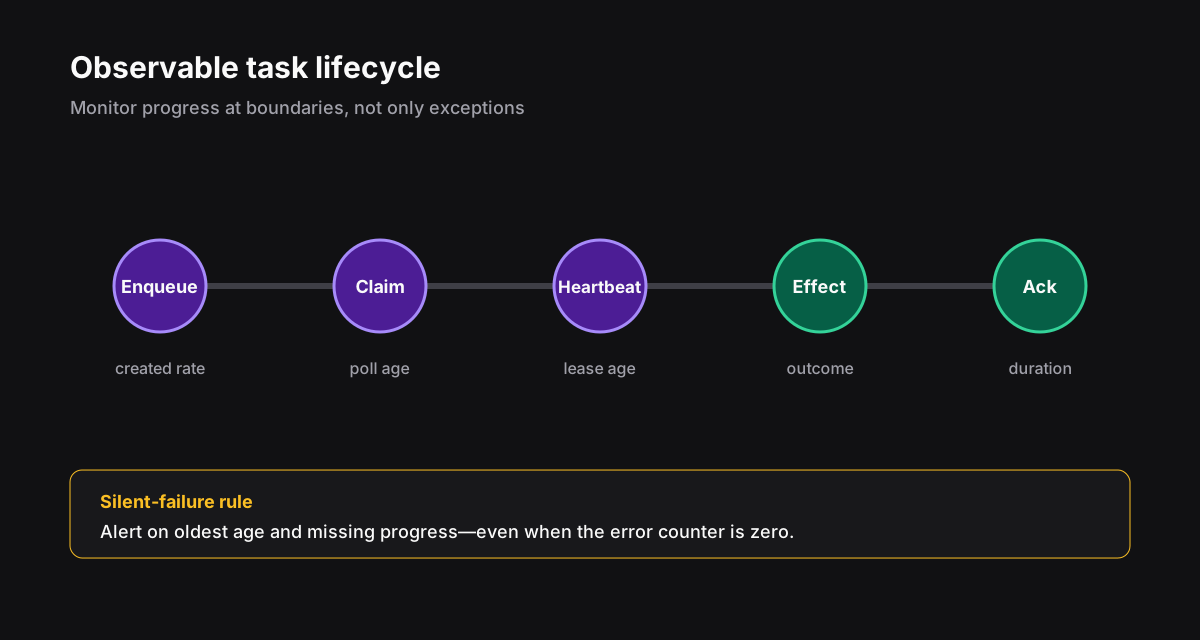
A self-hosted workflow engine is production-ready only when its recovery and operating procedures are proven. Identify the authoritative database and derived stores, encrypt transport and storage, separate application and migration roles, automate backups, and test a point-in-time restore into an isolated environment. Define recovery point and recovery time objectives from the business process, not from infrastructure defaults. Monitor worker polling, queue age, heartbeat delay, task duration, lease conflicts, database latency, locks, connection use, and dependency failures. Rehearse worker death during a long task, one unavailable worker pool, an exhausted database pool, slow external responses, and rollback after a schema migration. Pin engine versions and treat application, worker, CLI, and database compatibility as one release contract. Self-hosting replaces vendor dependency with operational ownership, so include security patching, restore drills, capacity planning, and on-call work in the cost. A successful backup job alone is not recovery evidence; a validated restore is.
Evidence: PostgreSQL: backup and restore · Kubernetes: Pod lifecycle
Start with the durable data#
A successful backup job is not recovery evidence. Time a restore, validate record counts and invariants, then start the engine against the restored copy without contacting production dependencies.
- Document the authoritative database and every derived store.
- Encrypt transport and storage; separate application and migration roles.
- Automate backups and test point-in-time restore into isolation.
- Record recovery point and recovery time objectives.
- Keep workflow definitions needed by active runs.
Make capacity and shutdown observable#
| Area | Minimum control | Failure drill |
|---|---|---|
| Workers | Poll, heartbeat, duration metrics | Kill during a long task |
| Queues | Age and depth by handler | Stop one worker pool |
| Leases | Expiry and conflict metrics | Partition a worker |
| Database | Latency, locks, connections | Exhaust the pool |
| Dependencies | Timeouts and circuit policy | Return slow 5xx responses |
Treat upgrades as data changes#
Pin engine versions, read migration notes, back up, rehearse on copied data, canary one environment, and keep a tested rollback window. Do not assume a container rollback reverses a database migration.
For Orch8, keep the engine, migrations, CLI, and worker contract compatible. Assign an incident owner before production and write the support bundle operators must collect.
What does self-hosting make your team responsible for?#
Write an ownership map before installation. Name the teams for control-plane availability, execution database, worker fleets, network and identity, backups, upgrades, observability, incident command, security response, and application-level effect safety. The engine can persist transitions, but it cannot own provider idempotency, customer communication, or business compensation.
Define service tiers by workload. A billing workflow and a disposable cache refresh may share infrastructure but should not share retention, recovery objectives, or paging policy. Document expected throughput, peak burst, maximum acceptable queue age, active execution count, history growth, timer volume, and tenant isolation. Capacity plans without workload semantics usually optimize the wrong bottleneck.
Keep configuration, schemas, dashboards, alerts, and runbooks versioned beside deployment manifests. Record who approves changes to retention, retry defaults, encryption, and destructive controls. A production cluster is an operational product, not a package that becomes finished after the first successful start.
| Domain | Required owner | Evidence |
|---|---|---|
| State store | database/platform | restore test and capacity forecast |
| Engine | platform | SLO, alerts, upgrade runbook |
| Workers | application teams | compatibility and shutdown tests |
| External effects | business integration owner | idempotency and reconciliation |
How should execution data be protected?#
Classify workflow inputs, outputs, errors, logs, and search attributes. Persist references instead of secrets when possible, encrypt transport and storage, rotate credentials, and restrict worker and operator identities to required namespaces and actions. Search convenience can leak sensitive values into indexes, traces, and backups, so apply the same data policy to every derived store.
Set retention by legal, support, replay, and provider dispute needs. Deleting completed history too early removes audit evidence; retaining payloads forever increases breach impact and storage cost. Separate compact business receipts from verbose execution details where their lifetimes differ. Test deletion and export paths, including backups and replicas.
Backups are not proven until restored. Schedule restore exercises into an isolated environment, validate schema and engine compatibility, count executions and timers, and run read plus controlled resume tests. Record achieved recovery point and recovery time. Protect backup credentials and audit access because backups often contain the broadest data set.
- Encrypt in transit and at rest.
- Use scoped worker, operator, and backup identities.
- Redact secrets before logs, traces, and search indexing.
- Declare retention and deletion for every copy.
- Restore on a schedule and measure RPO/RTO.
- Review tenant isolation with adversarial tests.
Which capacity and failure tests matter?#
Load-test the full path with realistic state size, history growth, timers, polling, and database contention. Average throughput is insufficient. Include burst admission, slow handlers, retry storms, a hot tenant, worker rollout, and control-plane restart. Watch queue age, transition latency, database locks, connection pools, storage growth, poll efficiency, and operator query performance.
Inject failure at durable boundaries: terminate a worker before and after effect dispatch, expire a lease, pause the database, delay acknowledgements, remove one availability zone, and restart the scheduler. Verify accepted state is preserved and recovery does not multiply external effects. Run these tests after substantial engine, database, SDK, or timeout changes.
Set admission limits before overload. Per-tenant quotas, queue concurrency, payload limits, and backpressure protect recovery traffic from new work. Document which workloads degrade first and how operators pause admissions without killing active executions. Capacity headroom should cover a stated failure scenario, not an unexplained percentage.
scenario: worker dies after provider accepts request
assert: one effect intent remains authoritative
assert: lease expires and stale completion is rejected
assert: reconciliation recovers provider receipt
assert: alert and runbook identify the boundaryHow do you upgrade and operate the engine safely?#
Read release notes for storage migrations, protocol changes, SDK compatibility, removed configuration, and rollback limits. Test the exact upgrade path on a restored production-shaped snapshot. Start old-version workflows, upgrade the control plane and workers in supported order, then resume timers, signals, retries, and external-effect reconciliation.
Canary one environment or shard and compare SLOs, queue age, transition errors, database load, and operator queries. Back up before irreversible migrations and define the decision deadline for rollback. Do not assume the binary can roll back after the database schema advances; prove it or document forward recovery.
Practice incidents with named roles and current contacts. Runbooks should cover lost polling, database saturation, timer backlog, credential expiry, bad worker deploy, unknown external effects, backup restore, and security isolation. After each exercise or incident, convert the missing evidence into an alert, dashboard, guardrail, or automated test.
What should a quarterly readiness review prove?#
Run a restore, rotate one non-production credential, fail over a worker pool, replay the incident contact tree, and inspect capacity against the next peak. Sample executions for retention, redaction, tenant isolation, and version compatibility. Confirm every critical alert has a current owner and every destructive control requires the intended authorization.
Review dependency support windows, database growth, backup cost, recovery objectives, security findings, and upgrade backlog. Record evidence and owners for gaps with deadlines. A checklist is valuable only when it exercises the mechanisms; marking backup configured or alert exists without a restore or routed test creates confidence rather than resilience.
Invite at least one application owner to trace a consequential workflow from admission through provider receipt. Platform availability can be healthy while business recovery is unsafe. The cross-team trace exposes unclear responsibility for effect reconciliation, compensation, and customer communication before a real incident does.
- Restore and resume a controlled workflow.
- Demonstrate isolation and least privilege.
- Compare capacity with a declared failure scenario.
- Review pending engine and database upgrades.
- Exercise incident roles and communication.
Sources and further reading
Official references support technical claims; community discussions are used only as problem signals.