By Orch8 Engineering · Editorial policy
Inngest vs Hatchet for Durable Workflows
Choose Inngest when the workflow reads naturally as an event-triggered function with named steps. Choose Hatchet when the process is easier to operate as worker tasks, static dependencies, or a durable parent that spawns children at runtime. Both can wait for an event, but the code you write around the wait and the work that resumes differ.
What is the practical answer?
Inngest and Hatchet both support workflows that survive interruption. Inngest models work as event-triggered functions with named steps. Completed step results are available when the function re-enters. Hatchet models work as worker tasks and can use a durable parent that waits for events or starts child tasks. Its durable parent replays checkpointed operations, so keep branching deterministic and perform external I/O in child tasks. Use the same approval workflow to compare them. Send a matching decision while one run waits, submit it again, then send a late decision to a separate timed-out run. Keep a durable record of the request so an early callback does not disappear before a wait is registered. Finally, stop a worker after a fake provider accepts a write. Verify that retry reuses the business identity and reconciles the provider result. Choose the model whose behavior your team can explain and recover during an incident.
Evidence: Inngest step primitives · Inngest event waits · Inngest self-hosting · Hatchet durable tasks and deterministic replay · Hatchet durable event waits · Hatchet self-hosting
Compare the units that recover#
Both tools can run background work, persist progress, and suspend execution while an event is pending. A fair comparison starts with how you model the workflow. Inngest resumes a function by running it again and returning saved results for completed steps. Hatchet supports a static graph of tasks and a durable task that rebuilds its control flow from recorded checkpoints. Put external writes in retriable steps or child tasks and give each write a stable business ID.
| Decision | Inngest | Hatchet |
|---|---|---|
| Where does application logic go? | Named steps inside an event-triggered function. | Worker tasks. A durable parent can spawn children based on earlier results. |
| How does a run resume? | The function re-enters and reuses results from completed named steps. | A durable task replays recorded operations and moves past completed checkpoints. |
| How do you wait for approval? | Match an event to the run or address a single run with a signal. | Wait for an event from the durable task context and match the business request. |
| What do you operate when self-hosting? | Inngest server and app functions. The server can use external PostgreSQL and Redis for larger installations. | Hatchet control plane and PostgreSQL, plus workers. Deployment options include Hatchet Lite and Kubernetes. |
Model the same approval in both products#
Take a document export that needs a reviewer. Prepare the file, request review, wait for a response for 24 hours, then send the approved version. Give the review request an application-owned ID and store the version of the artifact the reviewer saw.
In Inngest, prepare and send through named steps. Correlate the review event to the request ID. Its event wait only sees events sent after it starts listening, so handle very fast callbacks with durable application state or arrange for the wait to be in place before a response can arrive.
In Hatchet, put preparation and delivery in worker tasks and use a durable parent to decide what to do after each result. Treat the parent’s replayable code as deterministic. A branch should follow saved results instead of repeating a provider lookup whose answer may have changed.
Check the wait, deployment, and lost acknowledgement#
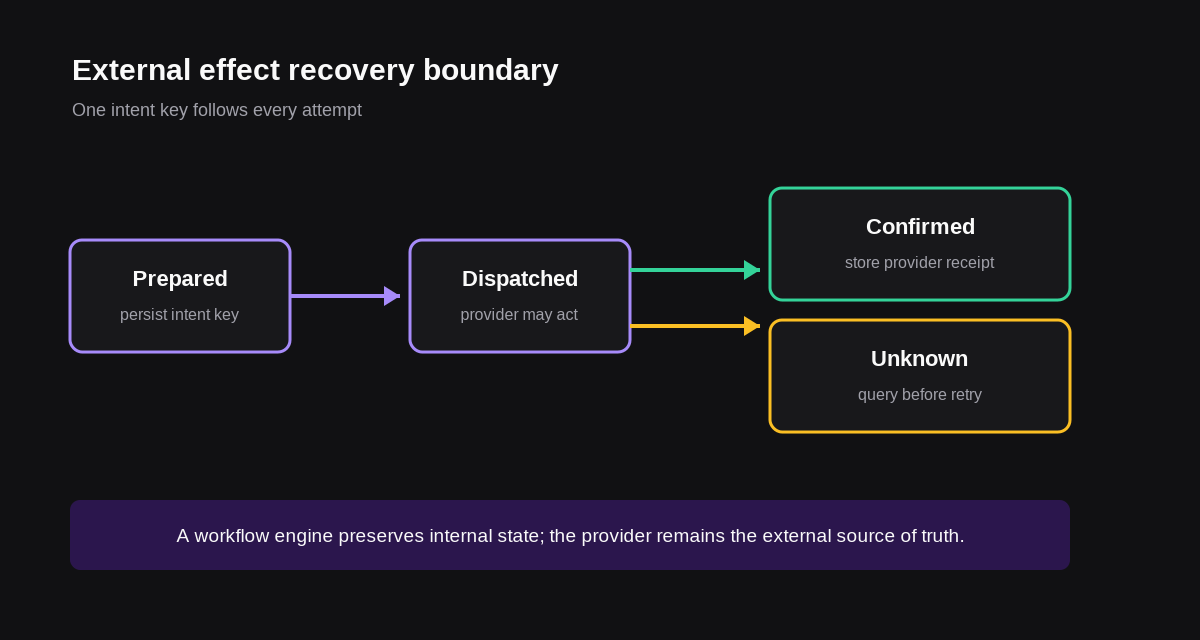
Use the same fake delivery provider on both sides. Kill an executor after the provider saves the send but before success is recorded. Restart with another worker and verify that the original delivery can be reconciled under the same intent key. Keep workflow checkpoints and provider receipts visible as distinct evidence.
Next, leave a run parked on review while deploying a changed workflow. Submit a prompt approval, a duplicate approval, and a late response to separate fixtures. Check that the intended run resumes once, that a timeout is observable, and that the old workflow can finish on a compatible deployment.
- Find the request, run, waiting condition, and eventual provider receipt in the operator view.
- Confirm a delivery timeout does not turn into an unreviewed duplicate send.
- Record which workers and deployment versions can finish runs that were already waiting.
Choose the model your team can diagnose#
Pick Inngest if existing event producers and named function steps make both the implementation and its troubleshooting simple. Pick Hatchet if worker ownership and explicit task dependencies are the natural way your team thinks about recovery. Compare hosted and self-hosted service costs using one verified business outcome, including waits, child work, deployment overhead, and repairs.
Orch8 publishes this comparison. When a portable JSON definition or offline execution on a supported device is a requirement, include its snapshot-based model in the evaluation.
Sources and further reading
Official references support technical claims; community discussions are used only as problem signals.